Monte Carlo simulation vs. SimDec
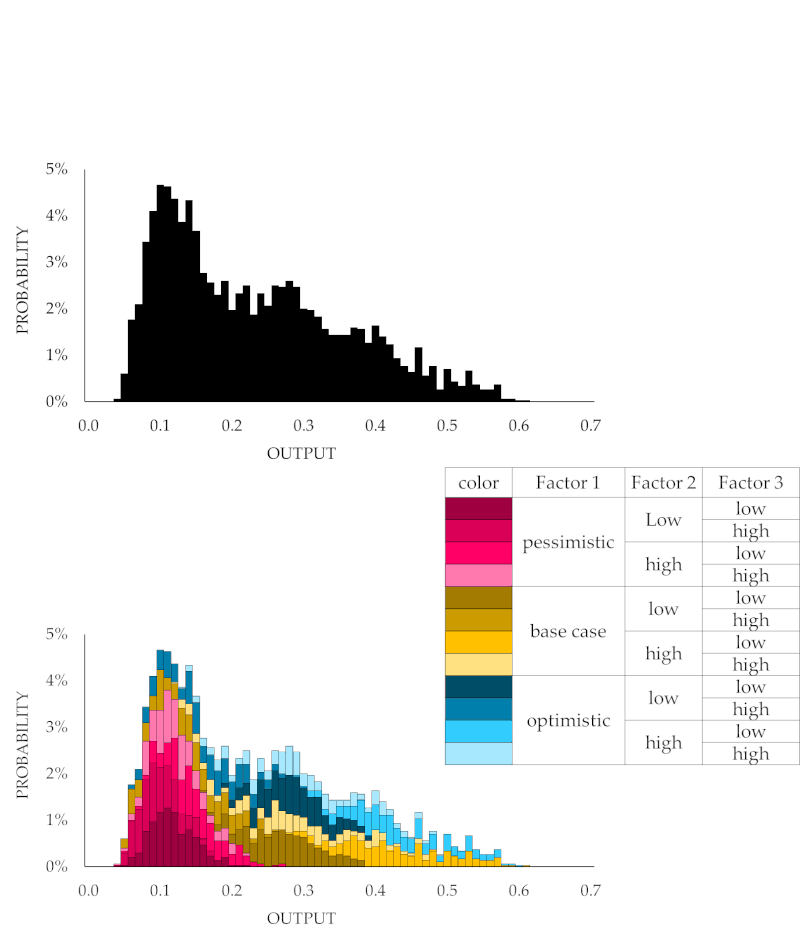
Monte Carlo simulation is excellent at showing the spread of possible outcomes. You run the model many times, vary the inputs, and get a distribution of results.
That is useful, but often incomplete.
A Monte Carlo histogram tells you what happened. It usually does not tell you which combinations of inputs created each region of the distribution, why peaks appear, or what separates a good outcome from a bad one.
SimDec adds that missing layer.
It takes the same simulation output and decomposes the distribution into clear, interpretable scenarios built from ranges of key inputs. Instead of staring at a mystery hump in a histogram, you can see which input conditions produced it.
Monte Carlo is strong when you want to:
- estimate uncertainty
- see the range and likelihood of outcomes
- test robustness under variable assumptions
SimDec, in addition, helps you:
- quantify the importance of input variables
- connect output regions to input conditions
- reveal interactions between variables
- explain non-linear behavior visually
- turn simulation results into decision-ready scenarios
When a distribution has multiple peaks, wide tails, or abrupt shifts, decision-makers usually ask the same question:
What is driving this? SimDec is built for exactly that moment.
SimDec insights would sound like this:
- 80% of my output variability is driven by the price and efficiency
- that nice region comes from high efficiency and high prices
- price drop has an adverse effect only when efficiency is low
- the second-best scenario is not bad at all!
The bottom line is: If your goal is only to quantify variation and estimate value at risk, Monte Carlo may be enough.
If your goal is to understand outcomes, communicate them, and act on them, show that simulation dataset to SimDec.
Already running Monte Carlo? You’re minutes away from SimDec insight
Just export the input–output dataset from your simulation and upload it to the free SimDec dashboard. In a few minutes, the platform will decompose your output distribution into interpretable scenarios.
If you need help getting started, see the quick tutorial or chat with the SimDec assistant.
